
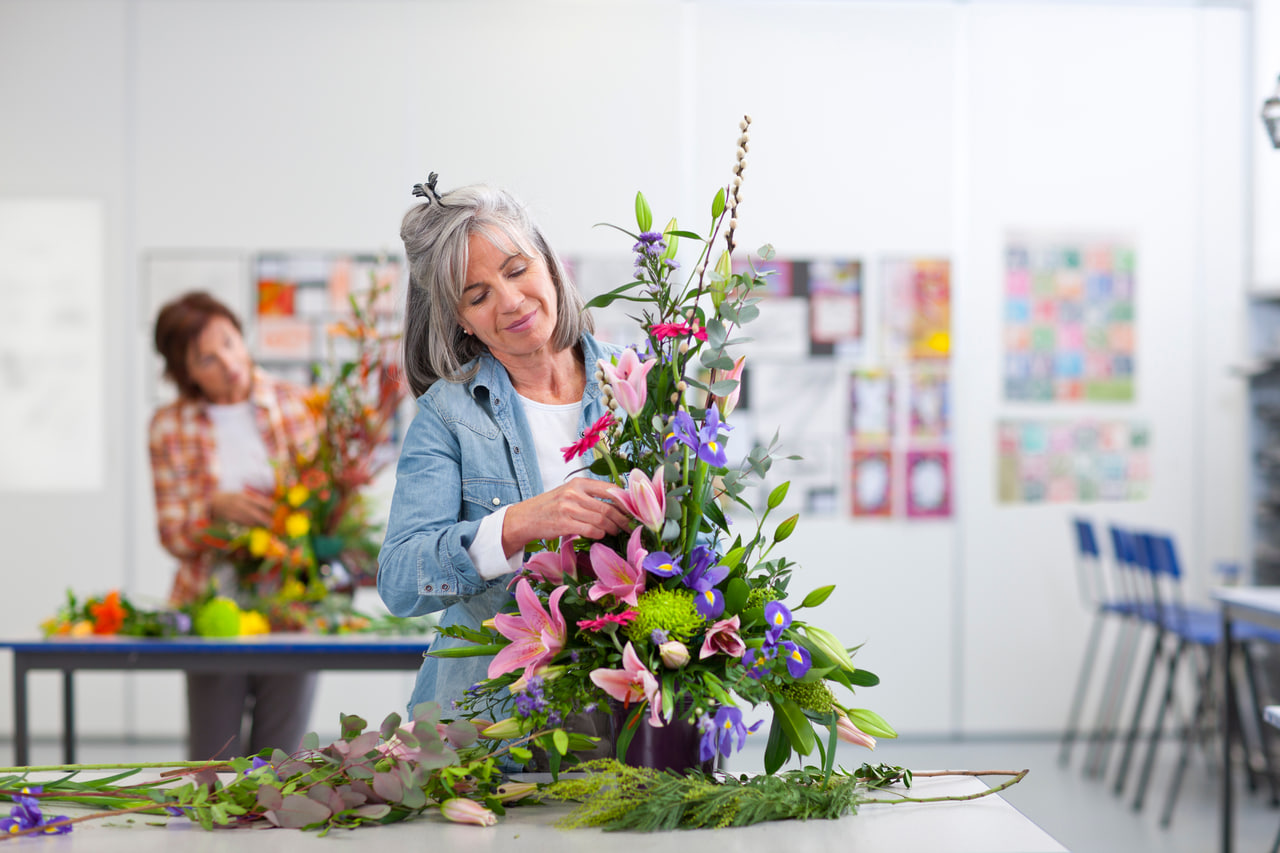
The Fundamentals of Modern Floristry: Essential Skills for Beginners
However, modern flower arrangements are not just about making flowers look pretty together. They involve horticultural understanding, mechanical skills, color story, scale control, and functional intention. Trends may come and go, but the mechanics and techniques behind them remain relatively constant and can be applied to any style. Once a novice learns the basics, they can move on to minimal, rustic, extra, or commercial styles without needing to relearn everything.
Contemporary flower arranging focuses on structure, knowledge of the materials and balance in an arrangement. Rather than teaching students how to replicate a shape, students learn about the construction of an arrangement, the mechanics of an arrangement and visual pathways. The mechanics are what distinguish between a technique from a fluke.
If you’re a beginner, learning the basics will save you from getting frustrated, using up too much paper, and creating shaky structures. Plus, it will help you learn faster as you have a solid base to start with for every new model you learn.
The Fundamentals of Hydrating and Cleaning Flowers
One technique I see many beginners overlook is prepping flowers. Flowers must be prepped before a design is started in order to preserve their longevity as well as make them easier to work with. Prepping flowers is an insurance policy for the mechanics and visual success of a design.
The stems should be cut again at an angle with a sharp knife or clippers to aid in water absorption. Any leaves that will be below the water level should be removed to prevent bacterial buildup. Many woody stems need to be slit or crushed at the base to help them drink. Some flowers need warm water and some prefer cool, and both practices will extend the life of your bouquet.
The timing of hydration is also important. For many flowers, they require a certain amount of time to soak before they can be used for an arrangement. I have seen new designers blame themselves for their work not turning out well, when in fact, it is because their flowers were stressed.
Clean containers and fresh water are also technique, not housekeeping. Bacteria reduces vase life and softens stems, which impacts structure and appearance.
The Must-Haves: Tools You Will Need and How to Use Them Properly
Unlike in the past, when hundreds of tools were needed, contemporary floristry is based on a handful of tools and techniques used correctly. Accuracy and safety are the first lessons a novice needs to learn.
Make sure your knives are sharp and use a good pair of flower shears. Nothing is worse than dull knives, which crush the stems, and you don’t want to use shears when you need to make angled cuts. Of course, a pair of stem cutters will be handy when you need to cut thicker stems, but don’t use them when a knife will suffice. Also, remember that floral tape, wire, and foam are all tools to support the flowers—not crutches to take the place of good technique.
This is technique — tool control. It’s how you get a clean cut to aid in water absorption. It’s how you place a wire to cradle a delicate flower without mechanics showing. It’s how you make a grid with tape for evenly spaced stems in a vase. It’s how new students that focus on tool control will progress more quickly and still achieve a polished end result, even with a basic design.
The same goes for maintenance. Wipe your tools, keep them sharp and it will keep your material and your hands safe as well as produce better results.
Which comes first, the decor or the framework?
The noob error is thinking about the flowers first. In the real world we start with structure. Structure dictates balance, stability and visual flow.
Structural items are branches, strong stems or skeletal frames (from tape or wire) that serve as the framework for the structure. They support less substantial items. In the absence of structure, pieces fall over, sag, or appear too dense.
The direction of the lines dictates the sense of movement within a piece. Vertical lines provide height and a sense of formality. Diagonal lines convey movement and vitality. Horizontal lines that are low and flat give a calming effect and create a sense of width. Novice students should practice establishing simple lines until they feel comfortable enough to incorporate the featured blooms.
I find that this idea of separating design into different elements and structures into hierarchical layers (structure, support, focal, secondary, detail) aids in this process.
Controlling Proportions and Size
Proportion refers to the proportion of the objects in the composition to one another, and the composition to the container. Scale is the proportion of the entire ensemble. These are both technical considerations, not common sense, and can be learned.
A rough rule of thumb for beginners is that the height of the arrangement will usually be 1½ to 2 times the height of the container. The width should look proportionate to the height, rather than necessarily equal unless you’re going for that specific look.
These big flowers are heavy, so don’t place them equidistant from one another. The little flowers and foliage help to disperse the weight. I find that students will often end up placing everything at the same level and the arrangement ends up looking flat. By having different stem lengths, there’s a sense of depth and importance.
A good proportion practice is to work with a restricted amount of plant material. It makes you think carefully about how to place and space the stems.
Focal Points
In every good design, there is a center of interest or focal point. A design that doesn’t have a focal point is chaotic. The focal point acts as a way to keep your eye anchored and gives the eye direction.
A focal point is anything that contrasts with the rest of the arrangement; bigger flowers, more intense color, more ruffly blooms or even interesting foliage. And it’s all about location. The focal point should be either just above or just below the midline of the arrangement. Not on the midline. That would look unnatural.
If you are new to this, choose your focal flower first and then select your base flowers to enhance that choice. Your base flowers should always flow into your focal area, not fight with it for attention.
Fewer focal flowers are easier to read. When there are too many focal flowers, it dilutes the focal.
The Basics of Color Harmony
Colors influence the mood and the level of professionalism. If you’re a novice, it’s better to use a limited color scheme, rather than attempting to use 10 or more colors at once.
Monochromatic color scheme: Using different shades of the same color. These are the easiest to balance. Analogous color scheme: Using colors that are next to each other in the color wheel. These schemes are often found in nature and are harmonious and soothing. Complementary color scheme: Using colors that are opposite from each other on the color wheel. These schemes are high contrast and can evoke strong emotions, but can be difficult to balance.
Neutral items, like foliage, stems, and filler flowers, provide a common ground between bold hues, and they minimize aesthetic strain. Color should be spread, not stacked — repeating colors in different areas provides rhythm and harmony.
In contemporary flower arranging, you typically use a limited color scheme with some deliberate juxtaposition, but not random mixing.
Contrasting Textures and Fabrics
Adding texture adds depth. Even with bright colors, arrangements will still look one-dimensional if there isn’t texture contrast. Try combining velvety blooms with prickly greens, bright blooms with feathery greenery, or anything shiny with something that’s more matte.
It has to be meaningful to introduce different textures. Every single texture you are using should contribute to your design, not ruin it. The rookie mistake is to combine too many textures at the same time. You can use 3 or 4 textures maximum for better readability.
Light bounces off texture as well. When a texture is reflective it will draw your eye to the object, if it is soft, it will make it recede. Again, you can use this to add more emphasis to any focal points you may have.
Balance Visual Weight
Symmetry isn’t balance. Many contemporary compositions are not symmetrical, but are balanced. The visual mass has to be balanced even if the forms are more energetic.
Counterbalance larger or darker flowers, foliage or flowers that are massed or grouped with empty space, or line, or lighter colors. If a side looks heavy, the arrangement will appear to be lopsided even if it is not.
For starters, stand back and look at the arrangement from all sides to determine balance. The piece can be turned to help spot any imbalances.
Negative space balances. The empty space is deliberate and highlights the space that is filled.